



Indoor lifting is often more complicated than outdoor lifting. In factories, shopping malls, basements, hotels, and commercial buildings, the available space is limited, access routes are narrow, and the floor load may be restricted. Traditional mobile cranes or truck cranes may not be able to enter the work area, while manual handling can be unsafe and inefficient.
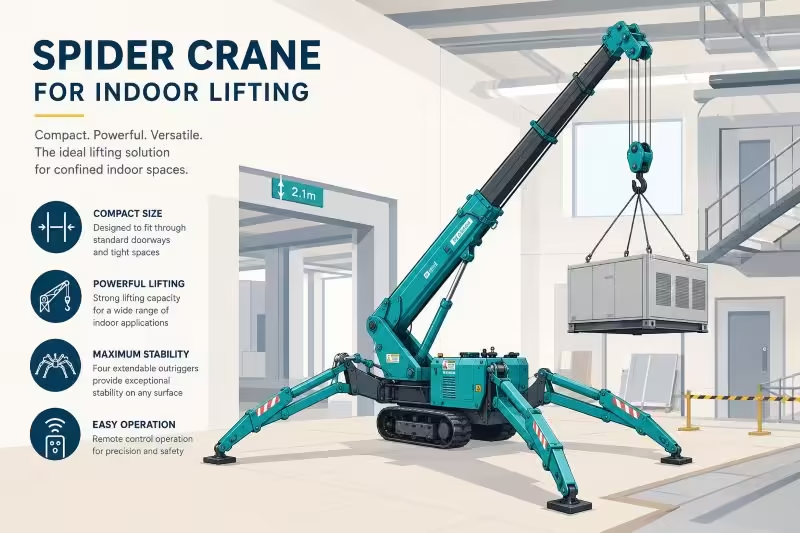
A spider crane for indoor lifting is designed to solve this problem. With a compact body, crawler travel system, stable outriggers, telescopic boom, and precise hydraulic control, it can complete lifting tasks in confined spaces where larger cranes cannot operate. It is widely used for glass installation, factory equipment maintenance, indoor steel structure assembly, machinery moving, basement construction, and commercial renovation projects.
This guide explains when to use a spider crane indoors, what specifications buyers should check, and how to choose the right model for safe and efficient lifting.
Table of Contents
What Is a Spider Crane?
A spider crane is a compact lifting machine equipped with crawler tracks and multiple outriggers. When the outriggers extend, they look like spider legs, which is where the name comes from. Unlike a standard mobile crane, a spider crane is built for restricted-access lifting jobs.
The main components usually include:
- Compact crawler chassis
- Telescopic boom
- Hydraulic lifting system
- Outrigger support system
- Remote or manual control
- Safety protection devices
- Load monitoring system
The biggest advantage of a spider crane is not only its lifting capacity. Its real value is that it can move through narrow entrances, work in limited spaces, and provide stable lifting performance inside buildings or restricted job sites.

Why Indoor Lifting Needs a Spider Crane
Indoor lifting creates several challenges that ordinary cranes may not handle well. Common problems include narrow doors, low ceiling height, limited turning space, finished flooring, nearby walls, restricted ventilation, and strict safety requirements.
For example, installing large glass panels inside a shopping mall requires accurate lifting and smooth positioning. Moving heavy equipment inside a factory may require a crane that can pass through workshop doors and operate close to production lines. In basement projects, the equipment must work under low headroom and limited ventilation.
A spider crane for indoor lifting helps solve these problems because it combines compact travel size with strong lifting stability. It can reduce manual labor, improve positioning accuracy, shorten installation time, and lower the risk of material damage.
Main Applications of Indoor Spider Cranes
Glass Installation
Spider cranes are commonly used for glass curtain walls, hotel lobbies, shopping mall facades, office partitions, and atrium glass structures. Large glass panels are heavy and fragile, so they require smooth lifting control and precise positioning. When used with glass suction equipment, a spider crane can greatly improve installation safety and efficiency.
Factory Equipment Maintenance
Factories often need to move or install heavy machines, motors, molds, tanks, or production line components. Forklifts may not provide enough vertical reach, and large cranes may not enter the workshop. A compact spider crane can move through narrow access routes and lift equipment into position with better control.
Indoor Steel Structure Assembly
For renovation projects, mezzanine installation, roof support work, and indoor structural upgrades, spider cranes can lift steel beams, frames, and support components in restricted areas. Buyers should carefully check boom length, working radius, and load chart before selecting a model.
Basement and Commercial Building Projects
Basements and commercial buildings often have narrow entrances and low ceilings. A spider crane can be used for HVAC installation, escalator component handling, pipe lifting, decorative structure installation, and equipment replacement. For enclosed areas, electric or battery-powered spider cranes may be more suitable than diesel models.
Key Specifications Buyers Should Check
When choosing a spider crane, buyers should not only compare maximum rated capacity. A 3 ton spider crane does not mean it can lift 3 tons at every working radius. The actual lifting capacity depends on boom length, working radius, outrigger position, load center, and ground condition.
Important specifications include:
- Rated lifting capacity
- Maximum lifting height
- Maximum working radius
- Boom length
- Travel width and height
- Machine weight
- Outrigger spread
- Ground pressure
- Power system
- Hydraulic system
- Control method
- Load chart
- Safety devices
- Spare parts availability
The load chart is especially important. It shows the safe lifting capacity under different boom lengths and working radii. A professional spider crane manufacturer should provide clear load chart information and help buyers select the right model according to the actual job site.
Spider Crane Capacity Selection Reference
| Spider Crane Type | Suitable Applications | Main Advantage |
|---|---|---|
| 3 ton spider crane | Glass installation, indoor renovation, light equipment handling | Compact size and flexible access |
| 5 ton spider crane | Factory maintenance, steel structure work, commercial projects | Stronger lifting capacity with compact operation |
| 8 ton spider crane | Industrial installation, larger glass panels, heavier components | Higher capacity for demanding indoor jobs |
| 12 ton crawler spider crane | Heavy equipment installation, infrastructure support, complex sites | Strong lifting performance and better site adaptability |
This table is only a general guide. The right model should always be selected based on load weight, lifting height, working radius, access route, and floor load conditions.
Spider Crane vs Traditional Mobile Crane
| Item | Spider Crane | Traditional Mobile Crane |
|---|---|---|
| Access ability | Better for narrow indoor spaces | Requires larger access area |
| Setup footprint | Compact with outriggers | Usually needs more space |
| Indoor usability | Strong advantage | Often limited indoors |
| Lifting precision | Suitable for delicate installation | Better for open-area heavy lifting |
| Typical use | Glass, factory equipment, indoor steel work | Outdoor construction and large lifting projects |
| Transport flexibility | Easier for restricted jobs | More complex for narrow sites |
A traditional mobile crane is still useful for open outdoor lifting. However, for confined-space lifting, indoor construction, and access-limited projects, a spider crane is often the more practical solution.
How to Choose the Right Spider Crane for Indoor Lifting
First, confirm the actual load weight and lifting radius. Do not choose a model only by rated capacity. Always compare the load chart with your working conditions.
Second, measure the access route. Check door width, door height, corridor space, turning area, elevator size if needed, and ceiling height. If the crane cannot reach the lifting point, its capacity will not matter.
Third, confirm the available outrigger setup area. Spider cranes need stable support during lifting. The floor must be strong enough to handle the crane weight and outrigger pressure.
Fourth, choose the right power system. Diesel models may be suitable for outdoor or well-ventilated areas, while electric or battery-powered spider cranes are often better for indoor projects with emission or noise restrictions.
Finally, evaluate the supplier’s technical support. A reliable spider crane manufacturer should provide load charts, operation manuals, safety guidance, spare parts support, customization options, and export documentation.

Common Mistakes to Avoid
One common mistake is choosing only by maximum capacity. Buyers must understand that lifting performance changes with working radius and boom extension.
Another mistake is ignoring access dimensions. A spider crane is compact, but every model has different travel width, height, and turning requirements.
Some buyers also forget to check floor load capacity. Indoor floors may need protection or engineering confirmation before crane operation.
The last major mistake is choosing a supplier without spare parts support. Hydraulic components, crawler parts, control systems, and safety devices may need maintenance over time. For overseas buyers, reliable spare parts supply is essential.
Final Thoughts
A spider crane for indoor lifting is an efficient solution for projects where traditional cranes cannot work easily. Its compact size, crawler movement, stable outriggers, telescopic boom, and precise control make it suitable for glass installation, factory equipment handling, indoor steel structure assembly, commercial renovation, basement construction, and narrow-space lifting.
When choosing a spider crane, buyers should evaluate lifting capacity, working radius, boom length, load chart, access dimensions, outrigger space, power system, safety devices, and after-sales support. The right equipment can reduce labor cost, improve lifting safety, and help projects move faster.
If you need compact lifting equipment for indoor or restricted-access projects, STCM Crane can provide spider crane model selection, technical specifications, customization options, and factory-direct lifting solutions.
FAQ
What is a spider crane used for indoors?
It is used for glass installation, factory equipment handling, indoor steel structure assembly, commercial renovation, basement construction, and machinery maintenance.
Why is a spider crane suitable for indoor lifting?
It has a compact body, crawler travel system, stable outriggers, and precise boom control, making it suitable for narrow and restricted spaces.
Can a spider crane pass through narrow doors?
Some compact models can pass through narrow doors or corridors, but buyers should check the travel width and height before selection.
Is a 3 ton spider crane enough for indoor projects?
A 3 ton spider crane is suitable for many light and medium indoor lifting tasks, but the actual capacity depends on working radius, boom length, and load chart.
What should I check before buying a spider crane?
Check lifting capacity, load chart, working radius, boom length, body size, outrigger spread, power system, safety devices, and spare parts support.