



Glass installation projects often require more than simple lifting capacity. Large glass panels, curtain wall units, window systems, and architectural glass structures need stable lifting, accurate positioning, compact access, and careful job site planning. In many cases, traditional mobile cranes or truck cranes are too large to enter the site or cannot reach the final installation position efficiently.
A spider crane is a practical solution for glass installation because it combines compact machine size, stable outrigger support, flexible movement, and controlled lifting performance. It can work in narrow areas, indoor spaces, building entrances, atriums, courtyards, and urban construction sites where larger cranes may not be suitable.
For contractors, curtain wall installers, glass companies, construction teams, and equipment rental businesses, choosing the right spider crane can improve installation efficiency, reduce manual handling, and make complex glass lifting work safer and more manageable.
For available models, buyers can review STCM’s Spider Crane Category Page: https://www.stcmcrane.com/product-category/spider-crane/
Why Glass Installation Needs Specialized Lifting Equipment
Glass is different from many other construction materials. It is heavy, fragile, large in surface area, and often requires precise positioning. A glass panel may not look extremely heavy compared with steel or machinery, but its shape, size, and fragility create special lifting challenges.
Common Challenges in Glass Installation
Glass installation projects may involve:
- Large panel size
- Fragile material handling
- Narrow site access
- Indoor lifting requirements
- Limited working space
- High installation points
- Building facade obstacles
- Wind impact on large panels
- Need for precise positioning
- Limited crane setup area
These conditions make equipment selection very important. A crane that is too large may not access the site, while a crane that is too small may not provide enough lifting capacity, reach, or stability.
Why Manual Handling Is Not Enough
For small glass panels, manual handling may be possible. However, larger curtain wall panels, insulated glass units, and high-position installations often require mechanical lifting support.
Risks of Manual Handling
Manual handling can create risks such as:
- Glass breakage
- Worker injury
- Poor positioning accuracy
- Slower installation
- Higher labor requirements
- Limited lifting height
- Difficulty working in narrow areas
A suitable spider crane can reduce these risks by providing controlled lifting and stable support.
What Makes a Spider Crane Suitable for Glass Installation?
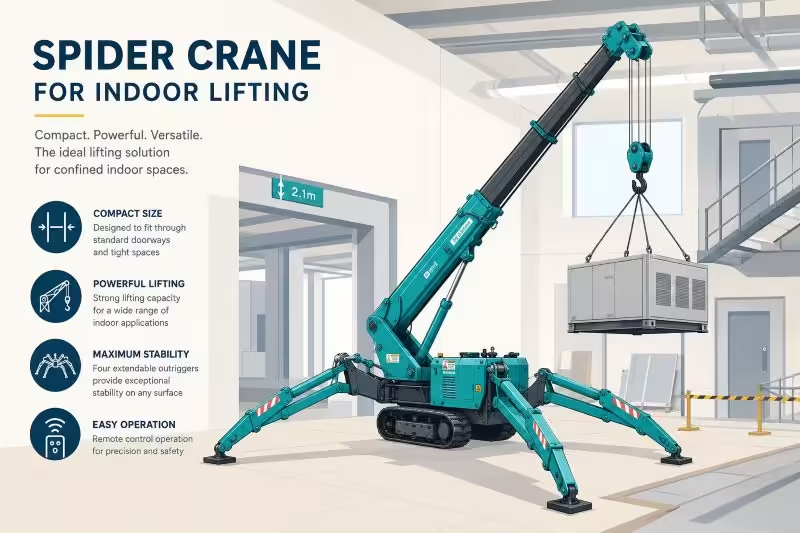
A spider crane is designed for lifting in restricted or complex spaces. Its compact body can enter areas where larger cranes cannot, while its extendable outriggers provide stability during lifting.
Compact Access
Many glass installation projects take place in locations with limited access, such as building interiors, courtyards, commercial centers, narrow streets, or finished construction areas.
Typical Access-Limited Sites
A spider crane is useful for:
- Shopping malls
- Office buildings
- Hotels
- Airports
- Exhibition halls
- Factory workshops
- Building atriums
- Courtyards
- Urban streets
- Renovation projects
The compact structure helps the crane move closer to the installation point, reducing the lifting distance and improving positioning efficiency.
Stable Outrigger Support
Spider cranes use outriggers that spread outward to support the machine during lifting. This helps improve stability, especially when lifting large glass panels that require controlled movement.
Why Outrigger Planning Matters
Even when the machine body can enter a site, the crane still needs enough room to deploy its outriggers safely. Before choosing a crane, buyers should measure both access space and working space.
Precise Lifting Control
Glass installation usually requires slow, smooth, and accurate movement. Sudden movement can damage glass or make positioning difficult.
Important Control Requirements
Buyers should consider:
- Smooth boom movement
- Stable hook control
- Suitable lifting speed
- Good operator visibility
- Compatibility with glass lifting tools
- Safe communication between workers
For some projects, glass vacuum lifters or other lifting accessories may be used together with the spider crane.
Common Glass Installation Applications
Spider cranes are used in many types of glass lifting and installation projects. The right model depends on glass weight, lifting height, working radius, site access, and installation environment.
Application Overview
| Application Area | Typical Use |
|---|---|
| Curtain wall projects | Lifting and positioning large glass facade panels |
| Building entrances | Installing glass doors, panels, and canopy glass |
| Shopping malls | Atrium glass, storefront glass, interior glass panels |
| Office buildings | Window panels, curtain walls, and facade units |
| Hotels and commercial buildings | Decorative glass, lobby glass, and exterior panels |
| Airports and stations | Large architectural glass and structural glass units |
| Factory workshops | Indoor glass installation and equipment area separation |
| Renovation projects | Glass replacement in restricted or finished spaces |
Curtain Wall Installation
Curtain wall projects often involve large glass panels installed on building facades. These panels must be lifted carefully and positioned accurately.
Why Spider Cranes Work Well
A spider crane can operate close to the building, work in narrow facade areas, and provide stable lifting support. When combined with proper glass handling equipment, it can improve installation efficiency and reduce manual lifting pressure.
Indoor Glass Installation
Indoor glass installation is common in malls, hotels, office buildings, exhibition halls, and atriums. These environments often have limited access, finished floors, and strict safety requirements.
Indoor Project Considerations
Before using a spider crane indoors, buyers should check:
- Entrance size
- Floor load capacity
- Ground protection
- Ventilation
- Electric power availability
- Working space
- Ceiling height
- Obstacle layout
For indoor work, electric or dual-power spider cranes may be more suitable because they can reduce emissions and noise.
Glass Replacement and Renovation
Renovation projects often have more restrictions than new construction projects. Existing walls, finished surfaces, furniture, equipment, and limited access can make lifting difficult.
Why Compact Equipment Helps
A compact spider crane can reduce disruption and allow lifting work to be completed in spaces where larger equipment cannot be positioned.
Choosing the Right Spider Crane for Glass Installation

Selecting a spider crane for glass installation should begin with the actual glass size, weight, lifting height, and working radius. Buyers should not choose based only on rated lifting capacity.
Step 1: Confirm Glass Weight and Size
The first step is to confirm the weight and dimensions of the glass panel. Large glass panels may be affected by both weight and wind.
Information to Prepare
Buyers should prepare:
- Glass weight
- Glass dimensions
- Glass thickness
- Number of panels
- Lifting point
- Installation height
- Whether a vacuum lifter is used
- Whether the glass must be rotated or tilted
Step 2: Measure the Working Radius
The working radius is the horizontal distance between the crane rotation center and the glass installation point. It directly affects safe lifting capacity.
Site Questions to Ask
Before selecting a crane, ask:
- Can the crane get close to the facade?
- Are there walls, fences, trenches, or obstacles?
- Is the ground suitable for outrigger support?
- Is there enough space for full outrigger deployment?
- Does the crane need to lift over structures?
- Is the installation point above ground level?
Step 3: Check Lifting Height
Glass installation often requires lifting to a facade, upper floor, atrium, or high interior area. The crane must have enough boom length and safe capacity at the required height.
Height-Related Factors
Check:
- Final installation height
- Boom angle
- Working radius
- Ceiling height for indoor work
- Whether the glass needs to pass over obstacles
Step 4: Confirm Access and Outrigger Space
A spider crane is compact, but it still needs enough space for safe operation. Both travel access and outrigger deployment must be checked.
Access Measurements
Measure:
- Entrance width
- Entrance height
- Turning space
- Working area width
- Ground slope
- Floor load limit
- Outrigger extension area
- Obstacle position
Step 5: Match the Crane Model to the Job
For lighter glass panels and very narrow indoor spaces, a 3 ton spider crane may be suitable. For heavier panels, longer reach, or higher lifting height, a 10 ton spider crane may be a better choice.
For compact glass lifting projects, buyers can review STCM’s 3 Ton Spider Crane product page: https://www.stcmcrane.com/product/3-ton-spider-crane/
For heavier lifting requirements, buyers can compare STCM’s 10 Ton Spider Crane: https://www.stcmcrane.com/product/10-ton-spider-crane/
3 Ton Spider Crane for Glass Installation
A 3 ton spider crane is commonly used for glass installation because it offers compact access and enough capacity for many light to medium-duty glass lifting tasks.
Best-Fit Applications
A 3 ton spider crane is suitable for:
- Indoor glass installation
- Curtain wall panel lifting
- Shopping mall glass projects
- Office building windows
- Atrium glass installation
- Glass replacement work
- Narrow facade areas
- Small to medium glass panels
Main Advantages
The 3 ton model is often chosen because it is compact, easier to position, and suitable for restricted spaces. It can work close to the installation point and reduce the need for larger lifting equipment.
When to Choose 3 Ton
Choose a 3 ton spider crane when:
- The glass weight is within safe capacity
- The access space is narrow
- The working radius is moderate
- The project is indoors or near a facade
- Precise positioning is more important than heavy capacity
10 Ton Spider Crane for Heavier Glass and Construction Work
A 10 ton spider crane is more suitable when the project requires stronger lifting capacity, longer reach, or higher installation points.
Best-Fit Applications
A 10 ton spider crane can support:
- Larger glass panels
- Heavier curtain wall units
- Higher facade installation
- Industrial glass projects
- Complex construction sites
- Projects requiring longer working radius
- Jobs needing a stronger safety margin
Main Advantages
The 10 ton model provides stronger lifting performance and wider application flexibility. It can handle more demanding lifting tasks while still maintaining the access advantages of a spider crane.
When to Choose 10 Ton
Choose a 10 ton spider crane when:
- The glass panel is heavier
- The working radius is longer
- The lifting height is higher
- The site requires stronger lifting stability
- The project includes both glass and other construction materials
Spider Crane vs Other Glass Lifting Methods

Glass installation can be done with different lifting methods, including manual lifting, forklifts, truck cranes, mobile cranes, and spider cranes. Each method has different advantages and limitations.
Comparison Table
| Lifting Method | Best For | Limitation |
|---|---|---|
| Manual handling | Small glass panels | High labor risk, limited height and weight |
| Forklift | Ground-level material movement | Limited lifting height and positioning accuracy |
| Truck crane | Outdoor sites with road access | Requires more working space |
| Mobile crane | Large exterior lifting projects | Higher cost and larger setup area |
| Spider crane | Confined spaces, indoor glass, precise lifting | Requires outrigger planning and load chart checking |
Why Spider Cranes Are Often Preferred
Spider cranes are preferred when the installation site is narrow, indoors, or difficult for larger equipment to access. They can work closer to the lifting point and support more controlled positioning.
Safety Considerations for Glass Lifting
Glass lifting requires careful safety planning because the material is fragile and often large in surface area. Even when the weight is within crane capacity, wind, panel size, and positioning requirements can increase risk.
Before Lifting
Before lifting glass, check:
- Glass weight
- Glass size
- Lifting accessory capacity
- Vacuum lifter condition
- Working radius
- Boom angle
- Outrigger position
- Ground condition
- Wind condition
- Communication between workers
During Lifting
During operation, the crane should move slowly and steadily. Workers should avoid sudden load movement and keep clear communication with the operator.
Key Operation Reminders
Operators should:
- Lift within the load chart
- Avoid sudden acceleration
- Keep the glass stable
- Watch for wind impact
- Maintain a clear working area
- Stop operation if conditions become unsafe
After Installation
After the glass is positioned, the lifting accessories should be removed carefully. The crane should be retracted properly, and all equipment should be inspected before the next lift.
For general crane safety reference, buyers and operators can review OSHA crane, derrick and hoist safety guidance
Load Chart Planning for Glass Installation
A load chart is essential for confirming whether the crane can lift the glass safely at the required height and radius.
Why the Load Chart Matters
A spider crane may have enough rated capacity, but the actual lifting capacity changes with working radius and boom length. This is especially important when installing glass at height or over obstacles.
What Buyers Should Confirm
Before operation, confirm:
- Load weight including lifting accessories
- Working radius
- Lifting height
- Boom length
- Boom angle
- Outrigger position
- Ground condition
Common Load Chart Mistakes
Buyers should avoid:
- Only checking rated capacity
- Forgetting the weight of vacuum lifters
- Ignoring working radius
- Underestimating glass surface area
- Not checking wind conditions
- Not measuring outrigger space
- Choosing a crane without supplier confirmation
For broader mobile crane standards, ASME B30.5 is a useful external reference for mobile and locomotive cranes
How to Request a Spider Crane Recommendation for Glass Projects
To get a suitable crane recommendation, buyers should provide clear lifting information to the supplier.
Project Information to Provide
Prepare:
- Glass weight
- Glass dimensions
- Installation height
- Working radius
- Indoor or outdoor use
- Entrance size
- Floor or ground condition
- Outrigger space
- Power requirement
- Whether vacuum lifters are used
- Destination country
- Special job site restrictions
Questions to Ask the Supplier
Technical Questions
- Is this model suitable for the glass weight and size?
- What is the safe capacity at the required working radius?
- What lifting height can the crane reach?
- Can the crane work indoors?
- What is the required outrigger space?
- Is a load chart available?
- Can the crane work with glass lifting accessories?
Commercial Questions
- What is the production lead time?
- What export documents are included?
- How is the crane packed and shipped?
- Are spare parts available?
- What after-sales support is provided?
- Can technical guidance be provided after delivery?
If you need help choosing a spider crane for glass installation, contact STCM Crane with your glass size, weight, lifting height, and job site conditions
Recommended STCM Internal Links
Spider Crane Category Page: https://www.stcmcrane.com/product-category/spider-crane/
3 Ton Spider Crane: https://www.stcmcrane.com/product/3-ton-spider-crane/
10 Ton Spider Crane: https://www.stcmcrane.com/product/10-ton-spider-crane/
Construction & Infrastructure Solutions: https://www.stcmcrane.com/construction-infrastructure-solutions/
Manufacturing and Industrial Facility Solutions: https://www.stcmcrane.com/manufacturing-and-industrial-facility-solutions/
Contact STCM Crane: https://www.stcmcrane.com/contact-us/
FAQ About Spider Cranes for Glass Installation
Can a spider crane be used for glass installation?
Yes. A spider crane is commonly used for glass installation because it provides compact access, stable outrigger support, and controlled lifting in narrow or indoor areas.
What size spider crane is suitable for glass lifting?
The right size depends on glass weight, panel size, lifting height, working radius, and job site access. A 3 ton spider crane may be suitable for many compact glass projects, while a 10 ton spider crane is better for heavier or higher installations.
Is a spider crane suitable for indoor glass installation?
Yes. Spider cranes are often used indoors in malls, hotels, factories, office buildings, and atriums. Buyers should check entrance size, floor load capacity, ventilation, and power requirements before operation.
Can a spider crane work with a glass vacuum lifter?
In many glass lifting projects, spider cranes can be used with suitable glass lifting accessories such as vacuum lifters. Buyers should confirm accessory weight, lifting point, and compatibility before operation.
Why is working radius important for glass installation?
Working radius affects the crane’s safe lifting capacity. A glass panel that is safe to lift close to the crane may require a larger crane if it must be lifted farther away or over obstacles.
What information should I provide before choosing a spider crane?
You should provide glass weight, glass size, lifting height, working radius, entrance size, floor or ground condition, outrigger space, power requirements, and whether lifting accessories are used.
Is a spider crane better than a truck crane for glass installation?
A spider crane is often better for confined, indoor, or restricted-access glass projects. A truck crane may be better for open outdoor sites with enough working space and road access.
Conclusion
A spider crane is a practical lifting solution for glass installation projects that require compact access, stable support, precise positioning, and safe operation in narrow or complex environments. It is especially useful for curtain wall installation, indoor glass lifting, building facade work, renovation projects, and commercial construction.
A 3 ton spider crane is suitable for many compact and medium-duty glass lifting tasks, while a 10 ton spider crane is better for heavier panels, longer reach, higher lifting points, and more demanding construction conditions.
Before choosing a model, buyers should confirm glass weight, panel size, lifting height, working radius, access space, outrigger area, ground condition, and lifting accessory requirements. For project-based selection, contact STCM Crane with your glass installation details, and the team can help recommend a suitable spider crane model for your job site