




Truck crane load charts are one of the most important yet most misunderstood technical documents in lifting operations. While most cranes are delivered with detailed load charts, many capacity-related incidents occur because these charts are misread, oversimplified, or applied incorrectly in real job-site conditions.
This article explains how truck crane load charts work, how to read them step by step, and how to apply them safely in practical construction and infrastructure projects. The goal is not just to explain what a load chart is, but to help decision-makers avoid common interpretation mistakes that can lead to unsafe lifting operations.
Table of Contents
What Is a Truck Crane Load Chart?
A truck crane load chart is an official manufacturer document that defines the maximum allowable lifting capacity under specific operating conditions. It is developed through engineering calculations, testing, and compliance with international safety standards.
Unlike marketing specifications, load charts provide conditional capacity values based on factors such as boom length, working radius, outrigger configuration, and slewing angle. These values represent the maximum safe load, not a recommended operating target.
Load charts are legally and operationally binding. Operating outside load chart limits is considered unsafe regardless of operator experience or perceived control.

Why Are Truck Crane Load Charts So Critical for Safety?
Truck crane load charts exist because crane stability and structural limits change continuously during lifting operations. Even small changes in configuration can significantly affect allowable capacity.
Load charts account for:
- Structural strength of the boom and crane frame
- Tipping stability based on geometry and weight distribution
- Safety factors required by international standards
Without load charts, operators would rely on estimation, which is unacceptable for heavy lifting operations. Proper use of load charts is one of the most important safety controls in crane operation.
How Is a Truck Crane Load Chart Structured?
Although layout may vary by manufacturer, most truck crane load charts follow a similar structure.
Typically, a load chart includes:
- Boom length or boom configuration on one axis
- Working radius or boom angle on the other axis
- Allowable lifting capacity listed at each intersection
- Separate sections for different outrigger configurations
Some charts also divide capacity by slewing range, such as full 360-degree rotation or limited rear or side sectors.
Understanding the chart structure is the first step toward correct interpretation.
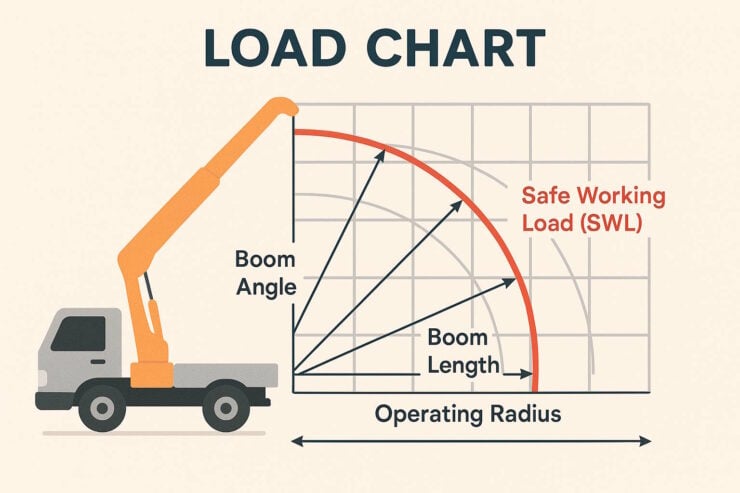
How Do Boom Length and Working Radius Appear in Load Charts?
Boom length and working radius are the primary variables in load charts.
Boom length is usually listed across the top or side of the chart, while working radius values appear along the opposite axis. The intersection of these two values indicates the allowable lifting capacity.
It is important to note that working radius is measured horizontally, not along the boom. Many miscalculations occur when radius is confused with boom length or boom angle.
Load charts always assume the maximum radius reached during the lift, not the average or starting position.
How Do Outrigger Configurations Affect Load Chart Values?
Outrigger configuration has a direct and often dramatic impact on load chart capacity.
Most load charts include separate tables or sections for:
- Fully extended outriggers
- Partially extended outriggers
- On-rubber or restricted configurations
Fully extended outriggers provide the highest allowable capacity. Partial or restricted deployment reduces stability and therefore reduces lifting limits.
| Outrigger Configuration | Typical Load Chart Capacity |
|---|---|
| Fully extended | Highest |
| Partially extended | Reduced |
| On rubber / restricted | Significantly reduced |
Operators must always confirm that the selected load chart section matches the actual outrigger setup on site.
How Are Safety Factors Reflected in Load Charts?
Truck crane load chart values already include safety factors defined by applicable standards and regulations. These safety factors account for uncertainties in material strength, dynamic effects, and operating conditions.
Because safety factors are built in, load chart values should never be exceeded. There is no acceptable margin for “temporary” overload or controlled exceptions.
Reducing risk does not mean exceeding load chart limits—it means planning conservatively within them.
How to Read a Truck Crane Load Chart Step by Step
A structured approach helps avoid misinterpretation.
First, identify the crane configuration, including boom length and attachments.
Second, determine the maximum working radius during the entire lift.
Third, confirm the outrigger configuration and ground condition assumptions.
Fourth, locate the correct load chart section for that configuration.
Fifth, read the allowable capacity at the intersection of boom length and radius.
Finally, subtract rigging and accessory weight from the chart value to determine net allowable load.
This step-by-step method reduces ambiguity and supports safe lifting decisions.
What Are the Most Common Load Chart Interpretation Mistakes?
Many incidents occur not because load charts are unavailable, but because they are misunderstood.
Common mistakes include:
- Using the wrong chart section for outrigger configuration
- Ignoring rigging and hook block weight
- Using minimum radius instead of maximum radius
- Assuming similar cranes share identical load charts
- Failing to update calculations when site conditions change
These errors are often the result of time pressure or overconfidence rather than lack of information.
How Do Load Charts Apply to Urban and Confined Job Sites?
Urban construction sites present unique challenges for load chart application.
Limited space may restrict outrigger deployment or slewing range. Nearby structures can force longer working radii than initially planned. Ground conditions may vary significantly across a small area.
In these environments, conservative interpretation of load charts and early planning are essential. In some cases, customized crane configurations or alternative lifting strategies may be required.
How Do Load Charts Differ Between Truck Cranes and Lorry Mounted Cranes?
Although both crane types use load charts, their structure and intent differ.
Truck crane load charts focus on higher-capacity, longer-reach lifting operations with multiple configuration variables. Lorry mounted crane load charts are generally simpler and optimized for loading and unloading tasks.
Understanding these differences helps ensure that the correct crane type and chart interpretation are applied to each project.
When Should a Load Chart Be Rechecked During a Project?
Load charts should be rechecked whenever lifting conditions change.
Triggers include changes in load weight, rigging setup, boom configuration, working radius, ground condition, or weather. Re-evaluation is also necessary when lifts are repeated under different site layouts.
Continuous verification is a hallmark of safe crane operation.
Conclusion
Truck crane load charts are not optional references—they are the foundation of safe lifting operations. Understanding how to read and apply them correctly is essential for preventing capacity-related incidents and ensuring regulatory compliance.
By treating load charts as dynamic planning tools rather than static documents, project teams can improve safety, reduce risk, and make better-informed crane selection and operation decisions.