



Table of Contents
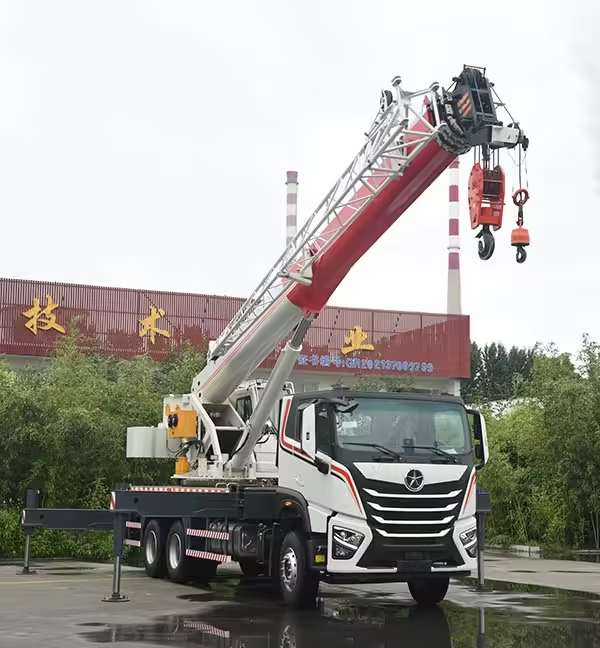
A heavy duty truck crane can make field lifting faster, cleaner, and easier to schedule, but only when the truck, boom, body, outriggers, and work pattern fit the same job. Many buyers begin with a capacity number. That is understandable, yet it misses the harder question: will the crane reach the load, stay stable on the surface, and still leave the truck useful for everyday travel?
This guide is written for project contractors, equipment owners, fleet buyers, and technical evaluators. It focuses on higher-capacity construction, industrial service, and infrastructure support and avoids sales shorthand that sounds good on a quote sheet but does not help at the jobsite. A heavy duty truck crane should be evaluated as a working vehicle, not just a crane bolted to a chassis.
Heavy Duty Truck Crane: Define the Real Work First
The best starting point for a heavy duty truck crane is the work list, not the maximum rating. Write down the normal load, the heaviest planned load, pickup height, set-down height, usual working radius, and how often the truck will move during a shift. Typical loads may include structural materials, machinery modules, large pipe sections, site equipment, precast elements, and heavy service components.
The buyer needs more lifting margin without overlooking road use, stability, operating radius, and support requirements. If that problem is not clear at the beginning, the final specification can drift toward a machine that looks impressive but feels awkward in daily use. A heavy duty truck crane should solve the repeated lift, not only the rare perfect-condition lift.
Check Capacity at Working Radius
Rated capacity changes as the boom extends and the working radius increases. A heavy duty truck crane may have enough capacity close to the truck but far less capacity when the load is several meters away. Ask for the load chart and review the radius points that match your actual tasks.
Do not judge a heavy duty truck crane by tonnage alone. Include rigging weight, hook weight, attachments, boom angle, and any site restriction that keeps the truck from parking close to the load. The useful capacity is the chart capacity at the hardest point in the lift path.
General crane safety guidance from OSHA’s cranes and derricks resources is useful context for planning discussions, while the mobile crane overview on Wikipedia gives neutral terminology for crane categories.
Match the Chassis to the Duty Cycle
The chassis controls much of the everyday experience. A heavy duty truck crane should have a chassis that suits road rules, route distance, terrain, turning space, axle loading, braking, and maintenance support. For city routes, compact turning and visibility may matter most. For construction yards or infrastructure routes, durability and ground clearance may carry more weight.
Buyers should ask how much payload remains after the crane, subframe, stabilizers, tools, and body are installed. A heavy duty truck crane that lifts well but leaves little room for useful materials may not be the right work vehicle.


Compare Common Configuration Choices
The table below gives a quick way to compare configuration priorities before requesting a final quotation for a heavy duty truck crane.
| Decision area | What to compare | Why it matters |
|---|---|---|
| Boom reach | Boom length, extension stages, load chart by radius | Reach only helps when capacity remains usable |
| Truck body | Deck layout, toolbox space, access steps, payload allowance | The vehicle must still support daily work |
| Outriggers | Spread, pad size, extension method, setup clearance | Stability depends on ground contact and level setup |
| Controls | Control location, smoothness, visibility, safety devices | Precise handling reduces rework and site delays |
| Serviceability | Hydraulic access, spare parts, inspection points, local support | Easy maintenance protects uptime |
Plan for Outriggers and Ground Conditions
Outriggers are not an afterthought. A heavy duty truck crane needs stable support under each pad, enough room for proper deployment, and a level setup before lifting. Soft fill, drain covers, asphalt edges, pavers, slopes, and unsupported slabs can all change the safe working plan.
Mat planning should be part of the normal lift process. If the heavy duty truck crane will work on varied sites, ask the supplier what pad reactions and outrigger footprint information can be provided for planning. Operators should stop if a pad settles, a mat shifts, or the truck loses level.
Think About Operator Visibility
Good control position and visibility can matter as much as raw capacity. A heavy duty truck crane used for repeated loading should allow the operator to see the hook, load, landing area, and nearby people clearly. Poor visibility slows work and increases the need for extra signaling.
Control smoothness also matters when placing materials near finished surfaces, equipment, or structural edges. A heavy duty truck crane with predictable hydraulic response can make ordinary lifts feel controlled instead of tense.
Review Hydraulic and Structural Details
A reliable heavy duty truck crane depends on hydraulic cylinders, hoses, valves, boom sections, slewing components, mounting structure, and safety devices working together. Ask about the hydraulic system layout, inspection points, hose routing, oil cooling, and access for routine maintenance.
Structural matching is just as important. The crane, subframe, and chassis should be treated as one system. A heavy duty truck crane is not simply a crane purchase; it is a vehicle build that must handle lifting forces, road vibration, and daily operating cycles.
Use Internal Product Pages as Reference Points
When comparing Sitong options, the 16 Ton Heavy-Duty Truck-Mounted Crane can serve as one reference point for the lower or mid-range side of the discussion. The 20 Ton Truck-Mounted Crane is useful when the project needs more reach, lifting margin, or a heavier-duty platform. These pages help buyers frame a heavy duty truck crane request with real product classes instead of vague capacity language.
That comparison should still be checked against the exact load chart, chassis configuration, and operating environment. A heavy duty truck crane is only the right choice when the configured vehicle fits the job pattern.
Procurement Checklist
Before asking for a final recommendation, prepare a short brief for the supplier. A clear brief helps the supplier match a heavy duty truck crane to the work instead of guessing from a single keyword.
- Normal and maximum load weight, including rigging
- Required working radius and lift height
- Ground surface and outrigger setup conditions
- Road distance, route type, and turning space
- Expected lifts per shift or per week
- Truck body needs, storage needs, and crew workflow
- Preferred service support and spare parts expectations
FAQs
What is this type of crane truck used for?
It is used for mobile lifting, loading, field repair, material handling, and service work where the vehicle must travel to the job and perform lifting without separate crane transport.
How do I choose the right configuration?
Choose the configuration by matching the load chart, working radius, chassis size, outrigger footprint, controls, and service needs to your real work cycle.
Is maximum tonnage the most important specification?
No. Maximum tonnage is only one condition in the load chart. A heavy duty truck crane should be checked at the actual radius, height, and setup conditions required by the job.
What should I ask the supplier before ordering?
Ask for the load chart, chassis details, outrigger dimensions, hydraulic system information, service guidance, and configuration options for the heavy duty truck crane.
Can the same crane truck handle different jobsites?
Yes, but only if the heavy duty truck crane has enough capacity, reach, ground support planning, and road suitability for each site. Different surfaces and access limits may require different setup plans.
Final Buying Advice
A heavy duty truck crane is a practical investment when the crane, chassis, body, outriggers, and controls are chosen around real work. The right machine should make daily lifting simpler, not just look stronger on paper.
If you are preparing a quote request, send the load weight, radius, lift height, surface conditions, route requirements, and duty cycle. Sitong can use that information to recommend a heavy duty truck crane configuration that fits the project instead of forcing the project to fit the machine.